

Every business owner is somewhere on the same journey. You are building something new, you are growing what you have, or you are getting ready to hand it to someone else. The work that creates value looks different at each stage, and knowing which one you are in tells you what to do next.
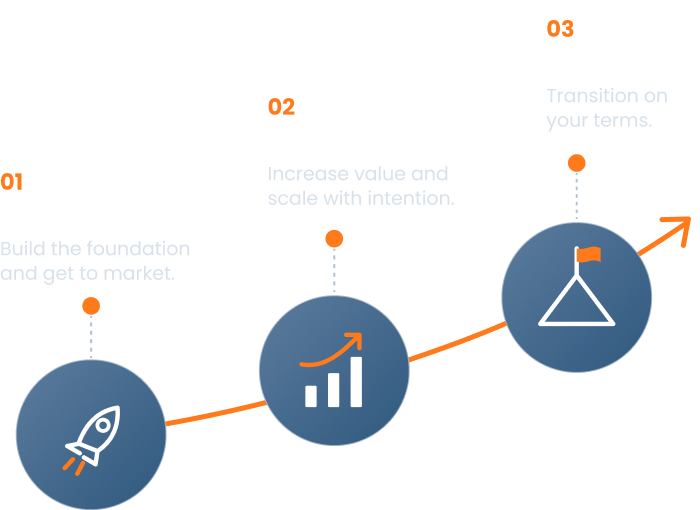
Exit Factor organizes everything it does around three stages: Launch, Grow, and Exit. Pick the one that sounds like your business today and the page behind it will tell you what matters most right now, what usually goes wrong, and how owners at that stage work with a Certified Exit Factor Consultant. If you are between two of them, or you have no idea, we would be happy to help.

Business Exits Behind the Model

Industries Served

Local Office Markets

VORTEx Phases
Every owner is building toward the same thing, a business that is profitable, that runs without them, and that someone else would want to own. What changes from stage to stage is the order of the work. In the first few years the highest-return move is usually setting up clean books and simple systems, because habits harden fast and fixing them later costs far more. In the growth years the work shifts to profit quality, reducing how much of the business depends on the owner, and choosing growth that a buyer will pay for. Close to a transition, the work narrows to proving all of it holds up under scrutiny.
The mistake that costs owners the most is treating exit preparation as something that starts when they decide to sell. By then the levers that matter most: clean financials, a team that runs the place, recurring revenue, documented processes, have passed you by.
Read the “this is you if” line on each one and take the first that fits. Most owners recognize themselves immediately. If two of them sound right, take the earlier one, because the foundation work pays off at every stage that follows.

Build a Profitable Small Business
This is you if:
You started a business in the last three years, or you recently bought one and you are planning your first chapter as the new owner.
What this stage is about:
The launch years are the cheapest time to build value and the easiest time to build it wrong. Decisions made now about financials, pricing, roles, and systems either compound quietly into value or quietly cap it. The goal is not just to survive the first three years, it is to come out of them owning something transferable.
What the work looks like here:
Getting the financial house in order from the start, pricing for profit rather than for volume, writing down how the work gets done, and building a business that is not simply a job with your name on it.

Grow My Business
This is you if:
You are past survival and growing, and you want the growth to be worth something to a buyer, a lender, or a successor.
What this stage is about:
A bigger business is not automatically a more valuable one. Plenty of owners scale revenue for years and find out at the end that they built a busier job rather than an asset. This stage is where growth gets pointed at value, so profit quality improves, the owner steps back, and the business keeps performing when they do.
What the work looks like here:
Improving margins and the quality of the financial story, replacing yourself in the day-to-day, documenting people and process, and choosing growth strategies that raise the multiple rather than just the top line.

Exit My Business
This is you if:
You are roughly three to seven years from handing the business to someone else, whether that is a buyer, your family, your employees, or a hired chief executive.
What this stage is about:
An exit is a set of choices, not a single event. Selling to an outside buyer, passing it to family, moving to employee ownership, hiring a chief executive and stepping back, or winding down on your own terms are all exits, and they demand different preparation. This stage is about picking the option that fits your life and then making the business ready for it.
What the work looks like here:
Choosing the exit option, closing the gaps that show up in due diligence, assembling the deal team, and protecting value through the transaction so the number at the closing table is the number you were promised.
Between two stages, or not sure at all? Keep reading, or Schedule a Free Consultation.
Stages do not have hard edges, and most owners sit on a line between two of them. A few honest sentences usually settle it.
The Fastest Way to Settle It
The Business Value & Growth Plan gives an owner a precise picture of what the business is worth today, a projected value twelve months out, and a score across the five VORTEx phases that shows exactly which parts of the business are carrying the value and which are holding it back. Most owners come out of it knowing their stage, their gaps, and their next move, whether or not they work with Exit Factor after that.
See What Your Business is Worth
Or skip the guessing and talk to someone. The free consultation is a ten to fifteen minute call, and placing you on the map is the first thing it does. Schedule a Free Consultation
Whichever stage you are in, the work follows the same five phases, known as the VORTEx Model™. It is the framework behind more than 2,000 business sales exits, and it is the reason moving from one stage to the next is a continuation rather than a fresh start.
Define your vision, your exit options, and the financial targets that connect today’s business to tomorrow’s transition. Core purpose: clarify the destination and reverse engineer the timeline.
Improve profitability and financial visibility through cleaner books, sharper margins, and a financial rhythm that surfaces issues early. Core purpose: increase EBITDA (earnings before interest, taxes, depreciation, and amortization) and the quality of the financial story.
Improve people, process, and technology management and efficiency, including systems and protection for automation and technology, including artificial intelligence (A.I.). Core purpose: make the business run without the owner.
Identify and implement growth strategies across customer expansion, product expansion, and acquisition growth. Core purpose: grow the top line and widen the value gap before exit.
Build the Exit Prep Scorecard™, line up the deal team, and prepare the business for a clean transition. Core purpose: protect value during the transaction and close on the owner’s terms.
Most of the work sits in Value and Optimize, setting the destination and building financial habits that will still hold in year ten.
The focus shifts to Record and Transform, taking the entrepreneur from owner to operator and pursuing profitable growth.
A full overview of the program focused on improving the due diligence process, valuation and final execution of exit.
Want the full methodology in book form? Read The Exit Factor by Jessica Fialkovich
Most frameworks describe a business as moving through a handful of stages, from getting established, to growing and professionalizing, to eventually transitioning to a new owner. The names vary, but the underlying idea is consistent: what creates value in year two is not what creates value in year twelve. Exit Factor uses three stages, Launch, Grow, and Exit, and organizes its methodology so that the work an owner does in one stage still counts in the next. A value growth company like Exit Factor will typically place an owner in a stage first, then recommend the work that belongs to it.
Age is a weaker signal than most owners expect. A thirty-year-old business bought last year behaves like an early-stage business, and a five-year-old business with a full leadership team may already be growth stage. The more useful questions are whether the business is consistently profitable, whether it runs when the owner is gone for two weeks, and how close the owner is to wanting out. Exit Factor answers this with a Business Valuation and Growth Plan, which scores a business across five phases and shows where it actually stands rather than where it feels like it stands.
The business owner journey describes the arc an owner travels from starting or buying a company, through the years of building it, to the point where they hand it to someone else. It is a useful lens because the owner’s own role changes at each point, from doing the work, to leading the people who do the work, to making the business run without them at all. Exit Factor maps this journey to three stages, Launch, Grow, and Exit, so an owner can see both where they are and what the next stretch asks of them.
Earlier than most do. The changes that raise a company’s value the most, clean and credible financials, a leadership team that runs the business, recurring or contracted revenue, documented processes, take years rather than months to put in place, and a buyer pays for a track record rather than a recent scramble. Two to seven years before a target transition is a common planning window, and owners with no timeline at all still benefit, because the same work makes the business better to own in the meantime. Exit-planning specialists like Exit Factor generally recommend starting while the exit is still hypothetical.
Profitability and structure, in that order. New and newly acquired owners tend to chase revenue and postpone the unglamorous work, then discover that messy books, undocumented processes, and total owner dependence are far more expensive to fix at year eight than at year two. The first three years are the cheapest window for building a business that is transferable rather than one that is simply busy. A service like Exit Factor can help an owner sequence that foundation work through its Launch path.
Yes, and most are. An owner can be running growth-stage revenue with launch-stage bookkeeping, or preparing for an exit while still fixing owner dependence. Stages are a guide to sequencing, not a diagnosis. When two stages fit, the earlier one usually points to the work that pays off fastest, because the later stage assumes the earlier foundation is in place. Companies like Exit Factor score across all five phases of their methodology precisely because most businesses are uneven.
No. Placing the business is the first thing a free consultation does. The call runs ten to fifteen minutes, covers where the business is, what the owner wants, and what the timeline looks like, and ends with a recommended starting point, which is sometimes a free resource rather than a paid engagement. Owners who want a data-backed answer instead of a conversation can start with a Business Valuation and Growth Plan.
Launch, Grow, or Exit, the next move is the same. Have a short conversation, get an honest read on where the business stands, and leave with one or two things worth doing this quarter. The consultation is free, it takes ten to fifteen minutes, and there is no pressure to go further than you want.