

Build Profit, Grow Business Value, and Exit on Your Terms
By Jessica Fialkovich, Author of the #1 Best-Selling Business Exit Book and Founder of Exit Factor
Whether you’re still doing everything, growing fast and stretched thin, or actively preparing to step away, The Exit Factor gives you the VORTEx Model™: a proven five-phase roadmap to build profit, grow business valuation, and exit on your own terms. Drawn from more than 2,000 successful business exits across 75+ industries, it’s the practical playbook every owner needs to reclaim time, money, and freedom.


Best Seller

Business Exits Behind the Model

Emerging Franchise Brand, Business Services

Industries




For owners in the Founder stage, where you ARE the business and everything depends on you.
For owners in the Builder stage, growing fast and ready to scale without breaking.
For owners in the Investor stage, ready to step back and prepare for a successful exit.
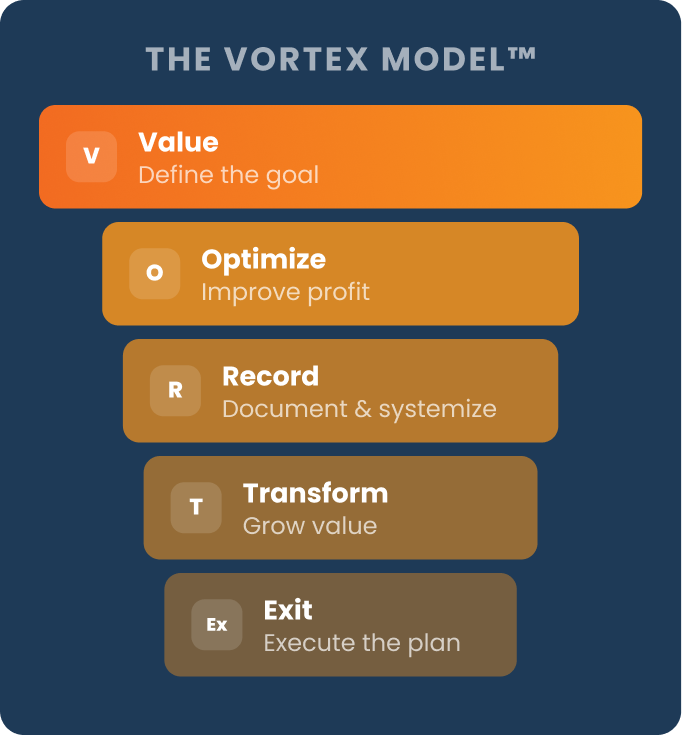
The Exit Factor introduces the VORTEx Model™, the five-phase methodology Jessica Fialkovich has used across more than 2,000 successful business exits to help owners build profit, grow value, and exit on their own terms. Whether you plan to sell in twelve months or twelve years, the book is designed to meet you where you are.
The Three Stages of the Entrepreneur (Founder → Builder → Investor) and the identity shifts every owner must make to build a transferable business.
The VORTEx Model™: a five-phase roadmap the areas you need to improve your business value.
How business valuations actually work, including EBITDA, seller’s discretionary earnings, and the multiples that drive sale price.
The five primary exit options (third-party sale, family transition, employee ownership, hired CEO with retained ownership, structured dissolution) and how to choose between them.
A 90-day implementation plan that translates the full framework into specific weekly actions, tailored to your exit timeline.
Real stories from across more than 2,000 business exits, including the mistakes that cost owners the most and the moves that paid off the biggest.
Want a taste of The Exit Factor book before you order? Enter your email and we’ll send you the first chapter free, plus the Exit Factor newsletter twice a month with practical strategies to grow business value, plan a successful exit, and make smarter decisions at every stage of the journey.

Jessica Fialkovich is a business exit expert, keynote speaker, and award-winning entrepreneur with almost two decades of experience in exit strategy, business growth consulting, and mergers and acquisitions. As Founder of Exit Factor, she has overseen more than 2,000 business exits across 75+ industries, working with thousands of owners to build companies that are more profitable, more valuable, and built to give them freedom on their timeline.
Jessica holds the Certified Exit Planning Advisor (CEPA) and Certified Business Intermediary (CBI) designations, making her one of the few advisors in the country credentialed across the full owner journey. Exit Factor now operates across 150+ U.S. territories and four international markets, and Jessica continues to mentor franchise owners while championing the broader mission: Exit Factor believes entrepreneurs deserve wealth, freedom, and options, and builds transferable businesses that make it possible.
The Exit Factor is Jessica’s second book. Her first, Getting the Most for Selling Your Business, focuses on the transaction itself and remains a foundational resource for owners actively going to market.
Certified across the full journey
Business exits overseen
U.S. territories
International markets
Bought The Exit Factor? Claim your free companion toolkit, the same six proprietary tools Exit Factor uses with paying consulting clients. Each tool maps to a specific phase of the VORTEx Model™ and gives you the worksheets to put every chapter into action.
Define what you want from your business in terms of time, money, and freedom.
Find where your business is leaking money and plug the holes.
Step out of the revenue, relationship, and responsibility roles that keep you stuck.
Identify the highest-leverage ways to grow without additional capital.
Choose your exit path and assess readiness across critical value drivers.
A diagnostic preview of Exit Factor’s comprehensive valuation and planning report.
Revenue is what your business brings in. Value is what your business is worth to a buyer. They are not the same thing. A high-revenue business with no documented systems, heavy owner dependence, or weak recurring revenue often sells for a lower multiple than a smaller, cleaner business. The Exit Factor explains how owners can grow business valuation, not just top-line revenue, and why most owners spend years chasing the wrong number.
Most small businesses sell for a multiple of EBITDA or seller’s discretionary earnings. The multiple itself is driven by factors buyers consistently pay premiums for: recurring revenue, documented systems, low owner dependence, low client concentration, clean financials, and growth trajectory. The Exit Factor’s Exit Prep Scorecard™ scores a business across these critical value drivers and identifies which one to focus on first.
EBITDA (earnings before interest, taxes, depreciation, and amortization) is the standard metric for valuing mid-sized businesses. SDE (seller’s discretionary earnings) adds one working owner’s salary and benefits back to EBITDA and is typically used for smaller, owner-operated businesses. Both are used to determine a valuation multiple. The Exit Factor includes a full chapter on how each is calculated, which buyers use which, and what “add-backs” are legitimate to include.
There are five primary exit options: selling to a third party (highest payout potential), transitioning to family, transferring to employees, hiring a CEO while retaining ownership, and structured dissolution. The Exit Factor walks through the pros, cons, and ideal-fit profile for each option, along with how to choose a primary path and a realistic backup. Most owners benefit from running two options in parallel.
For most owner-operated businesses, there are three buyer types: strategic buyers (competitors or adjacent businesses looking to expand), investment buyers (private equity and similar firms looking for 3-5x returns), and individual buyers (people leaving corporate jobs or experienced operators). The Exit Factor explains the psychology and priorities of each, plus how to identify your Most Probable Buyer so you stop preparing for the wrong audience.
According to research cited in the book, 87% of business owners in the U.S. never achieve a successful exit. The most common reasons are starting preparation too late, having books that cannot survive due diligence, being too dependent on the owner to be transferable, and treating valuation as a number to argue rather than a number to grow over time. The Exit Factor was written to address all four, with a specific framework for each.
If any of these challenges sound like your business right now, The Exit Factor has a specific phase, chapter, and tool designed to address it. Here are the most common starting points.
This is the most common starting point we see, and it maps to the Record phase of the VORTEx Model™. The Role Release Roadmap™ walks you through identifying which revenue, relationship, and responsibility roles to step out of, and in what order, so the business stops depending on you.
This maps to the Optimize phase. The Profit Pulse Plan™ helps you find where the business is leaking money and the highest-leverage fixes (usually pricing, margin, and overhead) that move profitability quickly. Buyers value businesses on a multiple of profit, so this is also one of the fastest ways to raise your valuation.
Most small businesses are valued at a multiple of EBITDA or SDE, and that multiple varies by industry, size, and owner dependence. The Exit Factor includes a free Exit Assessment™ that scores your business across the same dimensions buyers use, plus a full chapter on how valuation is actually calculated.
Section 3 of the book is built for this. Chapter 9 is a 90-day implementation plan that translates the full VORTEx Model™ into specific weekly actions, tailored to your exit timeline. Two to three years is exactly the window the book is designed for.
That decision belongs in the Value phase. The Exit Prep Scorecard™ walks you through the five primary exit options and helps you weigh each one against your personal, financial, and lifestyle goals.
The Transform phase is built around this. The 3-Growth Matrix™ identifies the highest-leverage ways to grow business value (not just revenue) without additional capital. The book walks through each lever, including organic growth, acquisition, and partnership-driven growth.
That’s actually an ideal place to start. The Value phase begins with the Value Vision Map™, a tool that helps you define what you want from your business in terms of time, money, and freedom, not just a sale price. The book is structured, so an owner with no exit plan can still get value from every chapter.
This is what the Exit Assessment™ is built for. The Exit Factor walks through how to evaluate an offer against your business’s true valuation, the buyer’s profile, and your personal goals. Receiving an offer doesn’t mean you have to accept it. If you’re going to negotiate, you need to know what your business is actually worth.
The Exit Factor book is just the beginning. Whether you want hands-on guidance on business growth, a clear business valuation, or a partner to help you prepare for a successful exit, Exit Factor has a path that fits.